


DSAG Annual Congress 2026: DHC between Practical Experience, Partnership and Personal Exchange
Three days at the DSAG Annual Congress in Cologne have come to an end. The focus was on personal encounters, practical contributions on release changes, end-to-end testing and computer system validation, as well as open dialogue about the future of the SAP ecosystem.


Three days at the DSAG Annual Congress in Cologne have come to an end. What remains are many valuable conversations, familiar faces, new contacts and exciting insights for our work in the SAP and Life Sciences environment. It was a pleasure to meet customers and partners again in person, continue discussions from ongoing projects face to face and exchange views with other SAP users on current challenges.
We were represented with two contributions in the Life Sciences and Processes working group, both developed together with customers from the field. The Life Sciences programme opened with a joint contribution by INFORMATICS Life Sciences and Hevert Arzneimittel on a validated S/4HANA transformation under GxP requirements. This was followed by two further contributions in which we shared insights into our project work together with customers: one on release changes and end-to-end testing, and one on computer system validation in an S/4HANA transformation.
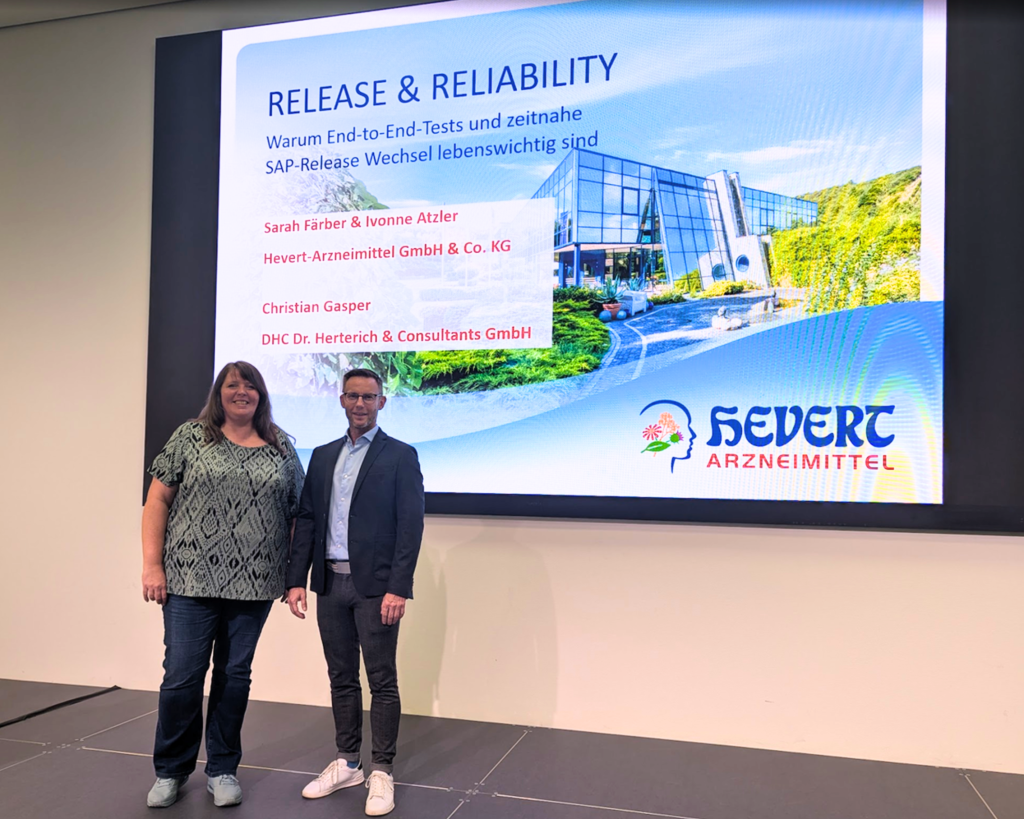
Release Changes and End-to-End Testing in a Regulated Environment
The first of these two contributions was presented by Sarah Färber from Hevert Arzneimittel and Christian Gasper, Practice Manager SAP Life Sciences and Partner at DHC. The focus was on the question of why functional testing alone is not sufficient when a release change affects end-to-end business processes and a complex system landscape.
A release change does not only affect individual functions. Data structures, custom developments, authorizations and interfaces may also be impacted. In a regulated environment, these changes must be tested in a controlled and traceable manner, with a focus on data integrity and patient safety.
Concrete examples demonstrated what matters in end-to-end testing: realistic test data, clearly defined responsibilities across system boundaries and structured defect management. Change freezes, the timely planning of testing resources and testing with users’ actual authorization roles are also essential.
Processes such as procure-to-pay and order-to-cash involve numerous systems and business departments working together. Errors in postings, tax codes, returns or interfaces to archiving, banking, tax and consolidation systems can have far-reaching consequences. The exchange within the working group showed how important it is to identify these dependencies at an early stage rather than discovering them only after go-live.
Computer System Validation in an S/4HANA Transformation
In the subsequent contribution, Leonie Schütt, Head of Computer System Validation at Vetter Pharma, and Dr. Luzi Barandun, Principal Consultant at DHC, showed how computer system validation can be integrated into an S/4HANA transformation.
The key question was not how to create as many documents as possible, but how validation can provide meaningful support throughout a project from the very beginning. This requires validation to be taken into account during the analysis, conceptual design and planning phases. GxP-relevant processes, data, interfaces, authorizations and data integrity requirements must be considered early and assessed on a risk-based basis.
Vetter Pharma’s approach demonstrates the difference that early involvement can make in practice. CSV thereby evolves from a subsequent documentation step into a sparring partner in the project. Requirements and responsibilities are clarified earlier, risks can be assessed more effectively and the necessary documentation can be focused on the areas that are actually critical.
The practical perspective was particularly valuable here as well: the new validation methodology was developed jointly with key users, Quality Assurance and IT. This creates not only a robust approach, but also a shared understanding of how compliance and efficient project work can go hand in hand.

Christian Klein, DSAG and the Path Ahead
On the third day of the congress, the focus turned to the future development of the SAP ecosystem. The panel discussion featuring Christian Klein, CEO of SAP SE, and the DSAG addressed SAP’s AI strategy, the Autonomous Enterprise and the question of how companies can turn technological possibilities into tangible value.
One point became clear: AI can only deliver an impact if the foundations are in place. Data quality, harmonized processes, a robust architecture and clear responsibilities are crucial for the reliable use of AI agents in day-to-day business. This path involves many practical questions, particularly in established and regulated SAP environments.
The perspective of user companies was equally important. DSAG made it clear that innovation must not stop at announcements. Customers need transparent roadmaps, support during implementation and solutions that also work in heterogeneous existing on-premise and hybrid landscapes. The discussion was open and, at times, emotional, but remained constructive – precisely what makes the dialogue between SAP, DSAG and user companies so valuable.
The discussion also took on a personal dimension with the change at the top of DSAG: Jens Hungershausen was farewelled as Chairman of the Executive Board, and Thomas Henzler was introduced as his successor. Christian Klein acknowledged his long-standing collaboration with Hungershausen. The change therefore does not represent a break, but rather the continuation of an important dialogue between SAP and its user community.
Three Days That Will Stay with Us
The DSAG Annual Congress is shaped by the topics discussed on stage – but at least as much by the conversations in between. For us, the personal encounters with customers, partners, familiar faces and new contacts were an important part of the three days in Cologne. Many of these conversations will stay with us in the coming weeks and feed into our joint project work.
We would like to thank DSAG for organizing the congress and providing an open environment for dialogue. We would particularly like to thank Sarah Färber and Christian Gasper for their contribution on release changes and end-to-end testing, as well as Leonie Schütt and Dr. Luzi Barandun for their joint presentation on computer system validation in an S/4HANA transformation.
We look forward to the next opportunities to meet and to continuing the conversations we have started.
Successfully Shaping S/4HANA Transformations in Regulated Environments
Would you like to learn how release changes, end-to-end testing and computer system validation can be effectively combined in a regulated S/4HANA transformation? Talk to our experts.
