ChaRM in the Cloud: Change Management with SAP Cloud ALM and the DHC Smart Validation Accelerator
In regulated life sciences companies, any change to an SAP system constitutes a change to a validated state. Whether it’s a configuration, a customization, or a new feature, it must be evaluated, approved, implemented, and documented. Anyone who tries to manage this using emails, Excel spreadsheets, and disparate tools will quickly lose track of everything. This is exactly where ChaRM comes in.
ChaRM (Change Request Management) in the cloud integrates change management in SAP systems with development and transport management in SAP Cloud ALM. The DHC Smart Validation Accelerator (SVA) complements this with GxP-compliant approvals, audit trails, and traceability.
Result: Every change—from the change request through to the transport—is documented, approved, and auditable.
Why Change Management in the Cloud Needs to Be Rethought
Cloud systems such as SAP S/4HANA Cloud, SAP Cloud ERP Private, or SAP Digital Manufacturing evolve in shorter cycles. Releases, feature rollouts, and configuration changes occur more frequently than traditional validation processes can accommodate. As a result, manual change controls become a bottleneck.
At the same time, requirements under GAMP 5, Annex 11, and 21 CFR Part 11 are increasing. Auditors expect you to be able to demonstrate at any time that:
- anyone who has requested a change
- what impact it has
- who reviewed and approved it
- when and how it was transferred to which system
The answer to this is an end-to-end process that combines change management and development management.
The Role of SAP Cloud ALM
SAP Cloud ALM serves as the leading system for projects, process documentation, requirements, solution specifications, test cases, defects, and transports. In SAP Cloud ALM, developers use features that enable changes to be transported across the system landscape.
However, without integration with the validation process, a gap remains: business approval and GxP documentation lie outside the development tool. The risk of unapproved transports to the production system increases dramatically and must be managed at the organizational level. This is where the DHC Smart Validation Accelerator comes in. Transports are embedded in a GxP change workflow. Uncontrolled changes are no longer possible.
Die Rolle des DHC Smart Validation Accelerator
The DHC Smart Validation Accelerator is a validation platform for SAP systems in regulated industries. As a solution extension to SAP Cloud ALM, it integrates change requests, approval workflows, validation documentation, and transports into a single process. The platform itself is developed and validated in accordance with GxP standards.
For ChaRM, this means specifically: The change request is managed in DHC SVA, the technical implementation takes place in SAP Cloud ALM, and both systems remain synchronized through defined statuses and links.
How ChaRM Works with DHC SVA and SAP Cloud ALM
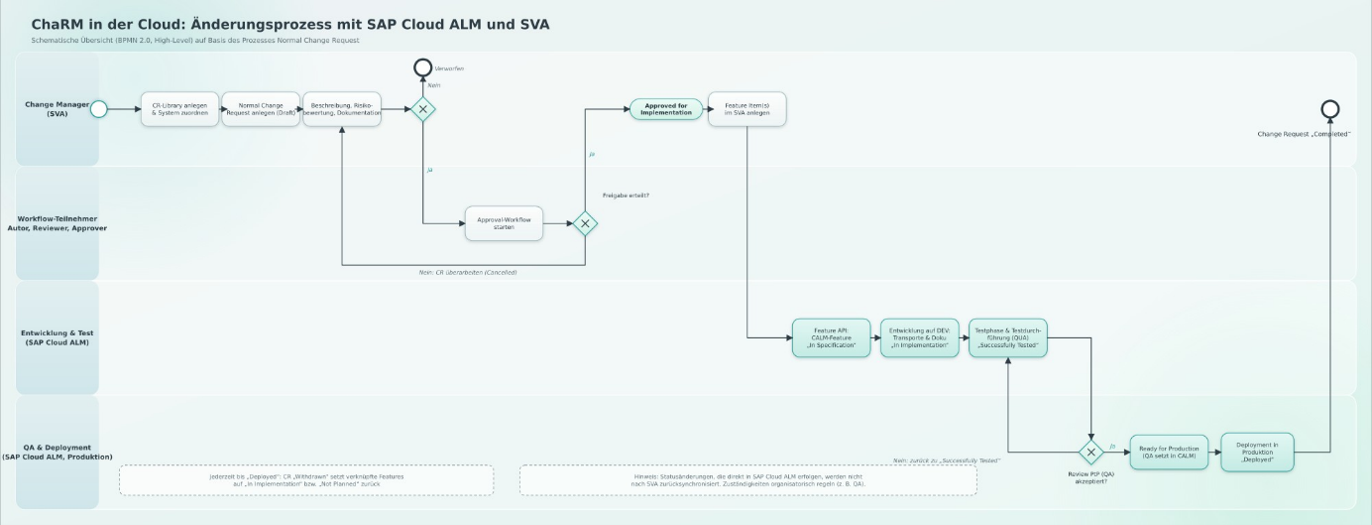
Figure 1: Change Management Process for a Normal Change, Including Roles in SAP Cloud ALM and SVA
- Structure: Library, Change Request, Feature
The process begins with a Change Request Library. It is assigned to a system or an SAP Cloud ALM project. This system is inherited by all subordinate change requests. This allows changes to be neatly structured by system, topic, or release without having to manually repeat assignments.
A Change Request can encompass multiple SAP Cloud ALM features. However, each feature is assigned to exactly one Change Request. The Feature Item in SVA corresponds to a feature in SAP Cloud ALM. - Approval Before Implementation
A change request is created as a draft and goes through an approval workflow involving the roles of author, reviewer, and approver. For approval, one signature each from the author, reviewer, and approver is sufficient; within the reviewer and approver groups, a single signature is sufficient. All participants are notified via email with a link to the process.
Only when the change request reaches the status “Approved for Implementation” can features be created in SAP Cloud ALM. This ensures that no development begins without documented approval. - Feature Creation and Synchronization
When a feature is created in SVA, a corresponding feature is automatically created in SAP Cloud ALM with the status “In Specification.” The title and description are copied, and the SAP Cloud ALM ID is stored in the SVA object. Changes to the title, description, and links made in SAP Cloud ALM are synchronized back to the SVA.
Important to note: Transports are managed exclusively in SAP Cloud ALM. The SVA controls the feature lifecycle, not the transports themselves. - Status Control Throughout the Lifecycle
The feature goes through clearly defined statuses: from “In Specification” through “In Implementation” and “Successfully Tested” to “Ready for Production” and “Deployed.” Status changes in the SVA are transferred to SAP Cloud ALM via the Feature API. If a change request is withdrawn, the linked features are automatically reset.
A practical tip: Status changes made directly in SAP Cloud ALM are not automatically reflected back in the SVA. Therefore, you should define responsibilities at the organizational level. You can deliberately assign critical steps—such as approval for production—to a dedicated role, for example, QA. This ensures the segregation of duties. - Traceability Across the Entire Lifecycle
Every change to the feature item is
- Structure: Library, Change Request, Feature
The Benefits of Combining SAP Cloud ALM and DHC SVA
| Challenge | Solution Using SAP Cloud ALM and SVA |
|---|---|
| Changes are made via email and Excel | An end-to-end process with statuses, roles, and notifications |
| Development and release are separate processes | Approval Before Implementation, Feature Status Synchronized with SAP Cloud ALM |
| Documentation for audits is time-consuming | Automatically Generated History and Links |
| Responsibilities are unclear | Defined roles for authors, reviewers, approvers, and feature status changes |
| Manage Validation Documents | Changes are directly linked to validation content |
| Avoid Uncontrolled Transfers to the Production System | Integration of the feature with transport control into the SVA Change Management process. Generation and control of the feature via the SVA. |
This results in three specific benefits for life sciences companies:
- Faster turnaround times: Approval and implementation are seamlessly integrated, eliminating duplicate work.
- Lower compliance risk: Every change is justified, approved, and documented.
- Stress-Free Audits: Documentation is created as part of the process, not just right before the inspection.
Who would benefit from ChaRM in the cloud?
ChaRM, with SAP Cloud ALM and the SVA, is primarily aimed at:
- Pharmaceutical Companies Using SAP Systems in a GxP Environment
- Medical device manufacturers with processes subject to validation
- Biotech and contract manufacturers that are required to document frequent changes
- Software providers in the GxP environment who want to map their own change processes in an audit-compliant manner
ChaRM is particularly relevant for companies that are currently transitioning to SAP S/4HANA or SAP Cloud ERP. This allows them to set up change management correctly from the start, rather than having to retrofit it after go-live. And for regulated life sciences companies that currently use SAP Solution Manager ChaRM to manage the change process in compliance with GxP and want to—or, due to the end of support in 2027, must—migrate to SAP Cloud ALM. Here, the DHC Smart Validation Accelerator fills the gap left by the absence of ChaRM in SAP Cloud ALM.
Conclusion: Master change instead of just managing it
GxP-compliant change management in the cloud is successful when change control, development, and validation are not separate entities. SAP Cloud ALM provides the technical platform for features, transports, and tests. The DHC Smart Validation Accelerator complements GxP-compliant control, release, and documentation. Together, they create a ChaRM process that enables agile further development of your SAP systems while keeping them ready for inspection at all times.
Would you like to know how ChaRM fits into your system landscape? Schedule a no-obligation consultation with our team and see the DHC Smart Validation Accelerator in a live demo.
Would you like to know how ChaRM fits into your system landscape?
Request more information or feel free to schedule a no-obligation consultation with our team to see the DHC Smart Validation Accelerator in a live demo.
Frequently Asked Questions About ChaRM, SAP Cloud ALM, and DHC SVA
What does ChaRM stand for?
ChaRM stands for Change and Request Management. It refers to the structured management of changes and requests in SAP systems, from the submission of a request through approval to implementation.
What is the advantage of combining SAP Cloud ALM with the DHC Smart Validation Accelerator?
SAP Cloud ALM manages features, tests, and transports. The SVA adds change requests, approval workflows, validation documentation, and audit trails. The two are linked through feature statuses and relationships.
Which regulatory frameworks does ChaRM support with the SVA?
The methodology is based on GAMP 5, Annex 11, and 21 CFR Part 11. The platform itself is developed and validated in accordance with GxP standards.
How many approvals are required for a change request?
The workflow requires one signature each from the Author, Reviewer, and Approver roles. Within the Reviewer and Approver groups, one signature is sufficient for each group.
Can a change request include multiple features?
Yes. A change request can include multiple features. However, each feature is assigned to exactly one change request.
Are transports managed in DHC SVA?
No. Transports are managed in SAP Cloud ALM. The DHC SVA controls the feature’s lifecycle.
Is the DHC Smart Validation Accelerator a cloud-based solution?
Yes, the solution is provided as a cloud-based solution with a scalable architecture.
Is an electronic signature available in the SVA?
Yes, each step in the ChaRM process is approved with a 21 CFR Part 11-compliant electronic signature. All changes are documented in an audit trail.
Does the DHC SVA need to be validated?
Yes, a validation package is provided for this purpose.